The Tisroc’s Palace
The Horse and His BoyThe Tisroc’s Palace is both a seat of Calormene royal privilege and a landscape of danger for Aravis: its secluded water-door gives her a way out of Tashbaan, but its innermost rooms expose her to the ruler, Rabadash, and the man she has been promised to marry. The contrast between magnificent public halls and concealed private spaces turns the palace into a passage from attempted escape to dangerous political knowledge.
Setting and Route of Escape
Lasaraleen’s solution to the problem of getting Aravis out of the city depends on the palace garden’s position beside the water. The garden runs down to the river and contains a small water-door, ordinarily reserved for palace people; boats are sometimes tied up beyond it. Lasaraleen proposes entering the palace after dark and slipping Aravis out through this private exit. Aravis immediately recognizes the stakes: if they are caught, their plan will be ruined.
The route is designed around privilege as much as concealment. Earlier, Lasaraleen arranges for grooms to lead the two horses out through the North gate, where a well-dressed groom with a war horse and a lady’s saddle horse would not attract questions. Aravis herself cannot simply follow them: Lasaraleen explains that a litter leaving the city would invite scrutiny. The palace water-door supplies the alternative, allowing the horses and their rider to take separate, less suspicious routes.
The Palace at Night
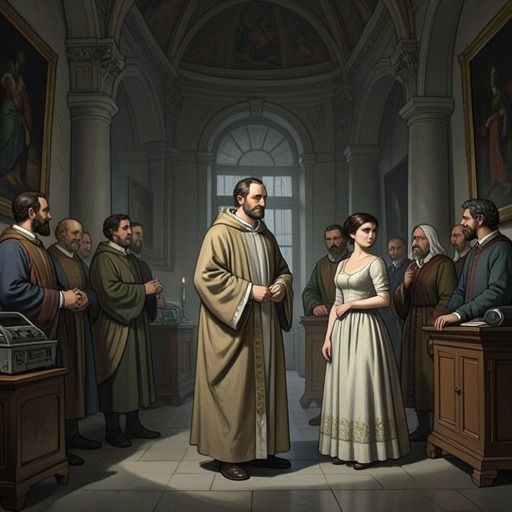
Aravis and Lasaraleen enter on foot after supper. Aravis disguises herself as a high-ranking slave-girl, with a veil over her face, while Lasaraleen is to pass her off as a slave being presented to a princess if anyone asks. Familiarity protects them at the gate: the officer knows Lasaraleen, calls the guards to attention, and salutes. They pass through the Hall of Black Marble, then the Hall of Pillars and the Hall of Statues, and continue along a colonnade beside the great beaten-copper doors of the throne room.
The public magnificence gives way to the more disorienting spaces of the Old Palace. Beyond a terraced garden-court, the girls enter corridors lit only by occasional torches. At a junction where the passage divides left and right, Lasaraleen loses her bearings. Aravis, whose heart is beating hard, urges her onward and fears that her father may appear at any corner. The palace’s scale and darkness, impressive from the halls, become immediate obstacles to the escape.
Hidden in the Council Room
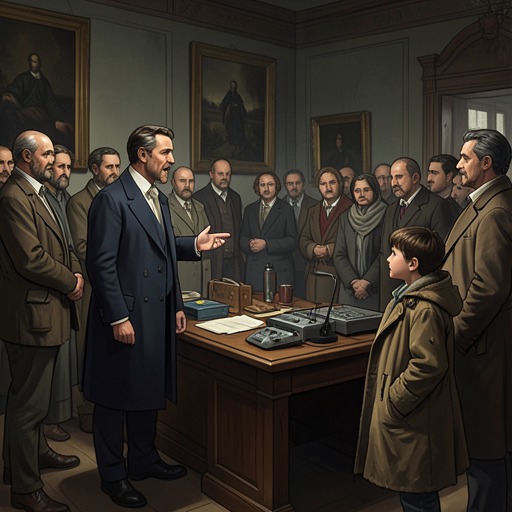
The girls hide behind a sofa in a room where Aravis cannot get her head fully out of sight. When the door opens and candles bring light into the room, she can see the people entering. Two deaf-and-dumb slaves carry the candles and take positions at either end of the sofa; their presence partly shields Aravis, who watches from behind one of them.
The Tisroc enters first, recognizable by his pointed cap and overwhelmed by jewels, frills, pleats, buttons, tassels, and talismans. Aravis privately judges that Narnian men’s clothes look better. Rabadash follows, wearing a feathered, jeweled turban and an ivory-sheathed scimitar; his excitement shows in his flashing eyes and teeth. Last comes the wizened, hunchbacked Ahoshta Tarkaan, the new Grand Vizier and Aravis’s intended husband. The Tisroc settles on a divan, Rabadash stands before him, and Ahoshta lowers himself onto his knees and elbows with his face to the carpet.
Political Knowledge and Narrative Significance
From her hiding place, Aravis hears Rabadash complain that the departure of the Narnian ship has put Queen Susan beyond his reach. He says that if the Tisroc had given him swift galleys at sunrise, he might have overtaken it, but that the delay spent checking whether the ship had merely moved to a better anchorage wasted the day. His anger makes clear that his desire for Susan is not a passing disappointment: he declares that he must have her and describes himself as unable to sleep or eat because of her beauty. The Tisroc answers with a measured appeal for composure, calling the departure of guests a wound that a judicious host can heal.
The palace thus brings its two functions into sharp collision. Its privileged access and private water-door may enable Aravis’s escape, yet the same secluded rooms let her overhear a ruler’s family and political affairs. The journey through ceremonial halls ends not at the exit she seeks, but at an unintended revelation: Rabadash’s pursuit of Susan is forceful and possessive, and the seemingly safe interior of the palace conceals the conversation that makes it legible.